The Camera-to-Post Blueprint:
Pre-Production and the On-Set Pipeline
By the time footage lands on my drive, most of the budget has already been spent or already been saved. The edit does not begin in the suite. It begins in a pre-production meeting, weeks before the first slate, when nobody else in the room is thinking about the edit yet. That is the cheapest place to solve a problem and the most expensive place to ignore one.
An editor who only shows up to receive footage is a luxury an indie feature cannot afford. On Baggage Claim, my involvement started upstream, because every decision about how the camera captures and how the data moves is a decision I will have to live with for the entire offline and finish. Getting it right before the camera rolls is what protects both the schedule and the story.
PRE-PRODUCTION: BUILDING THE BLUEPRINT BEFORE THE FIRST SLATE
Three things get locked before a camera rolls. Get them right and the post pipeline runs silent. Get them wrong and you spend the first week of the edit firefighting instead of cutting.
FRAME RATE
The entire production commits to a single base frame rate. For our regional broadcast and theatrical reality that means 25fps, with all high-speed material shot at a clean multiple and conformed back down inside the timeline. The failure mode is a shoot that quietly mixes 23.976, 24, and 25 across cameras because nobody made the call early. That mix does not surface on a monitor on set. It surfaces three weeks later as drifting sync and dropped frames in the conform, and by then the unit has wrapped and the fix is a manual repair on every affected clip.
MULTI-CAM AUDIO SYNC
Sync is a pre-production parameter, not a post problem to be discovered later. The sound recorder runs at 48kHz, 24-bit, and every camera carries jam-synced timecode from a lockit reference such as Tentacle Sync. Scratch audio stays on every camera as a waveform fallback. When the timecode discipline holds on set, the synchronized clips in Final Cut Pro build automatically and Resolve's auto-sync conforms without manual nudging on a per-setup basis. The sync workflow is defined once, in the blueprint, so that nobody is hand-aligning waveforms at two in the morning for material that should have matched on ingest.
COLOR SPACE
The color pipeline gets decided with the DP before the first frame, not negotiated after the grade has started. The choice is between ACES and DaVinci YRGB Managed, and it is driven by the shoot. A clean single-camera log capture sits comfortably in a managed YRGB workflow. The moment the production runs multiple camera bodies or mixed log formats, ACES earns its place by unifying everything through proper input transforms to a common reference. What matters is that the on-set monitoring LUT and the finishing transform descend from the same color science. When they do, what the director approves on the monitor is what I am grading against in the finish. There is no surprise shift between set and suite.
THE ON-SET PIPELINE: FINAL CUT PRO AT THE COALFACE
Nothing touches the edit before the data is safe. Every card is offloaded with checksum verification through Hedge or OffShoot, and no card gets formatted until two redundant copies exist and the checksums match byte for byte. That rule is non-negotiable, and it is the foundation everything else sits on.
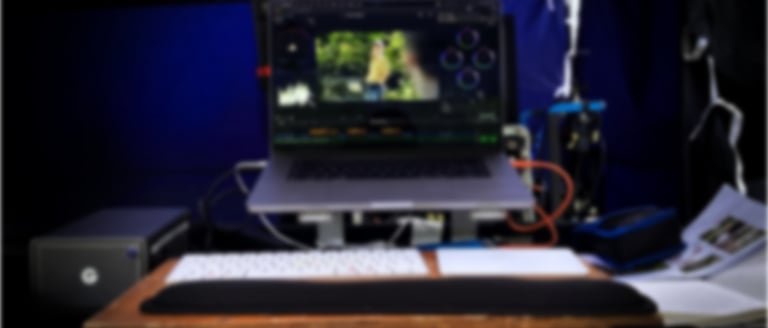
Once the media is verified, Final Cut Pro goes to work at speed. The reason FCP lives on set rather than Resolve is exactly that: speed. The magnetic timeline, background ingest, and the absence of render walls let me move at the pace the set demands. I ingest, then keyword, favorite, and reject on the fly, which means the footage is logged the moment it arrives instead of weeks later. From those selects I build a fast string-out that lets me read pacing and performance against a real cut while the lighting setup is still standing.
That last point is where the on-set pipeline pays for itself. If a beat does not land, if the coverage is thinner than the scene needs, if an eyeline is wrong, I see it in the string-out and flag it while the unit is still in position. A safety pickup taken on the day costs a few minutes of an existing setup. The identical shot recovered later as a reshoot costs a full day, a crew call, a relight, and a location you may no longer have access to. Catching it on set is the single highest-leverage thing editorial does to protect the budget.
THE HANDOFF: A CLEAN XML ROUND-TRIP INTO DAVINCI RESOLVE
The offline locks in Final Cut Pro, then moves to DaVinci Resolve for finishing as an FCPXML round-trip. Resolve relinks to the original camera files rather than the proxies, and I verify the metadata that the pre-production blueprint guaranteed: reel names, timecode, and frame rate carried through intact.
This is the moment the upstream discipline gets cashed in. Because frame rate and color space were locked before the shoot, the conform lands with zero translation errors instead of a list of offline clips Resolve cannot match. The timeline opens under the same color-managed space the footage was monitored in, so the grade starts from a known reference rather than a reconstruction. The XML is clean because the blueprint was clean.
THE THROUGHLINE
Pre-production, on-set editorial, and the finishing handoff are not three separate jobs. They are one continuous pipeline, and the editor's leverage is almost entirely front-loaded. Every parameter I lock before the slate and every pickup I catch while the lights are hot is budget and narrative momentum protected at the only point where protecting them is cheap. By the time Baggage Claim reaches the grade for its July screening at the Labia, the hard work of keeping the data honest and the story intact is long done. It was done on set.