WHO AM I AND WHY DID I START THIS JOURNAL?
EUVRARD LOUBSER
I've always found it helpful to know a little bit about the person behind a timeline or a piece of writing before diving into their technical breakdowns. It gives you a frame of reference. None of us create in a vacuum, and every creative choice we make, whether it's holding a shot for an extra beat or choosing where a scene should breathe, is shaped by our past experiences and the filters through which we view the world.
Editing is often talked about as a purely technical discipline: mastering the software, remembering the shortcuts, and keeping continuity clean. But those elements are just the baseline literacy; they aren't the language itself. The real work happens on a psychological level. It's about understanding human behavior, managing tension, and manipulating time to make an audience feel something subconscious.
Because the technical entries following this post will dive deep into the practical realities of the post-production pipeline, I wanted to start by sharing how my own visual filter was built.
TRACKING VISUAL RHYTHM
I was born in South Africa in January 1980, and my relationship with moving images started long before I ever stepped into a professional edit suite. Growing up around Cape Town, my life revolved around surfing, skating, and permanently carrying my parents' old Japanese handycam to film whatever my friends and I were doing. Looking back, that was my earliest education in pacing. Surfing teaches you to read the subtle changes in a line before it forms, and skating forces an acute awareness of timing and momentum. Holding that old camera wasn't about making "films" yet; it was simply a natural way of learning how to track movement.
After navigating the structured environment of boarding school at Paul Roos in Stellenbosch, I spent 1999 and 2000 living and working in London. It was the height of the grunge house party scene, a time for experiencing life rather than climbing a career ladder. I did some entry-level work in the film industry back then, but the real value of those years was sociological. I spent countless nights simply observing people at their most unguarded and expressive. When you watch human behavior in raw, unchoreographed environments, you naturally develop an eye for micro-expressions, shifts in body language, and the subtle cues that tell you what someone is actually thinking versus what they are saying. That baseline understanding is exactly what you rely on years later when you're trying to sculpt a performance out of raw rushes.
THE GLOBAL ACCENT AND THE SPLIT INSTINCT
When I returned to South Africa, I studied business management and marketing at the IMM Graduate School of Marketing. While it felt completely separate from filmmaking at the time, it ended up being an incredibly useful foundation. It taught me how the broader commercial machine operates, how brands communicate, and how to look at creative projects through the lens of long-term business strategy.
That was followed by a year of working and snowboarding in Colorado, then a road trip down the American West Coast through the Grand Canyon, San Diego, San Francisco, and Los Angeles. Immersing yourself in new cultural landscapes exposes you to different visual rhythms, varying paces of life, and unique ways people interact.
Eventually, I moved to Taiwan, where I spent four years teaching English and shooting video. My time there perfectly illustrates the dual instinct required in modern post-production. By day, I was teaching, which honed my ability to break down complex ideas clearly. On the side, I was out on the streets filming fast-moving lines on Sony VX2000 tapes for a local Chinese skate shop, a process that was entirely loose, handheld, and instinctive.
At the exact same time, I started working with a German industrial engineering firm, Trumpf, creating technical video assets for their laser and punch machinery. There was absolutely no room for creative instinct there. Every frame had to communicate a precise mechanical sequence with zero ambiguity, because people were going to operate heavy, dangerous industrial hardware based entirely on what I put on screen.
That sharp contrast, the loose, responsive hand of the skate videos balanced against the mathematical precision of the industrial engineering assets, became the backbone of how I approach a timeline today. High-end finishing work demands exactly that kind of split mentality.
FROM THE TRENCHES TO THE FEATURE
When I came back to Cape Town, I knew I wanted to commit completely to post-production, so I started at the absolute bottom. I took a job as an office and post PA at Giant Films. It was a year of long hours and menial tasks, but it was the most educational seat in the house. Being the person physically handling the drives and assisting the pipeline means you see the entire lifecycle of a project. You learn how a set actually functions, where the friction points hide, and how to translate what a director wants into a practical technical reality. I then broke away and started a small production company with my cousin working on african travel films for a few year.
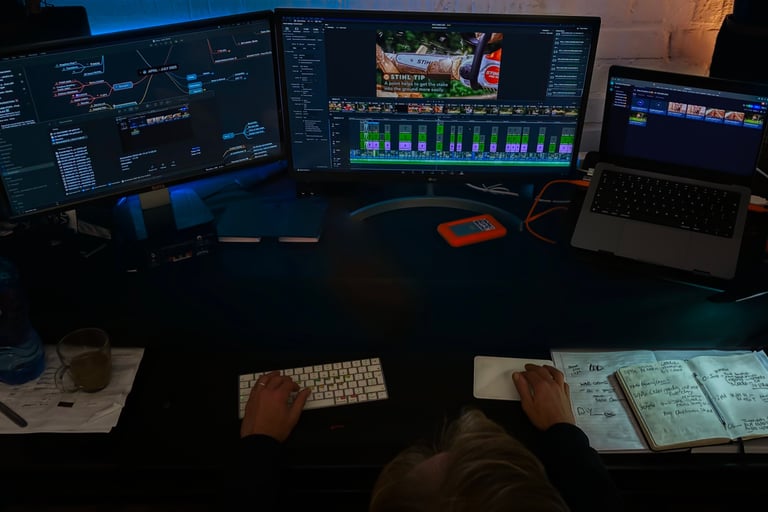
That grunt work led to a fifteen-year stretch in the commercial trenches. Collaborating closely with North South Production and director Jean-Paul Malherbe, I edited and finished hundreds of fast-turnaround commercial assets. On many of our major campaigns for brands like STIHL, L’Oréal, and various fashion clients, I managed the entire pipeline myself—handling everything from the onset editorial all the way through to the final finishing master. Cutting regional and international campaigns in this high-pressure environment is a brutal, brilliant testing ground. It strips away any bad habits and forces you to make definitive creative choices under intense agency pressure and tight deadlines. You learn exactly how to protect the core narrative beat when you only have thirty seconds to tell the story.
Recently, I've branched out into documentary work and gradually expanded that commercial discipline into narrative long-form. I spent the early part of this year finishing our indie psychological thriller feature, Baggage Claim. Transitioning into the sanctuary of a feature edit bay lets you use those same technical instincts, but it completely shifts the creative horizon. Instead of engineering a fast-paced commercial delivery, you get to focus on atmospheric world-building, deep psychological subtext, and letting a narrative arc slowly accumulate tension across ninety minutes.
WHY THIS JOURNAL EXISTS
The path to starting this blog wasn't an overnight decision; it came from a shared observation after a decade of working across commercial and indie timelines.
Technology has moved incredibly fast, making powerful editing and colour grading software accessible to almost anyone. But the joy of pushing buttons to get a clean technical result can feel a bit hollow if the aesthetic and narrative decisions behind those choices are missing. It takes years of consistent workflow pressure to truly understand why a specific cut feels right, or why a colour choice lands emotionally.
Opportunities for genuine professional mentorship are becoming harder to find in our industry. This Technical Journal is my way of opening up the edit bay window. It isn't a portfolio space to show off polished final reels, and it isn't a generic tutorial channel teaching software shortcuts. It's a high-signal, practical record of real-world post-production workflows—covering the file management structures, the timeline conform friction, the round-trip failures, and the actual creative logic used to solve them.
I'm building this space for directors, producers, and post-production supervisors who want a transparent, a real look at how a project moves from on-set ingestion to final theatrical delivery. The software and the tools change every single year, but the core psychological thinking behind a compelling story does not. That's what we're going to examine here.